 ultimate-guide
How to Find Your Style: 2026 Guide to Your Look
Table of Contents
- Start With Identity, Not Trends: How to Define Your Fashion Aesthetic
- Take a Personal Style Quiz (And What to Do With the Results)
- Dressing for Your Body Shape: Proportion, Silhouette, and Fit
- How to Build a Capsule Wardrobe That Still Feels Like You
- How to Find Your Style When Trends, Budget, and Doubt Get in the Way
- How to Find Your Style as It Evolves With Age, Career, and Identity
- Frequently Asked Questions
Last Updated: September 28, 2026
Start With Identity, Not Trends: How to Define Your Fashion Aesthetic
Most people searching for how to find your style start with the wrong question. They ask "what's trending?" when the real question is "who am I?" Most people struggle with the same loop: buy something trendy, wear it twice, feel like a stranger in it. Style isn't a trend you chase. It's an identity you clarify.
Personal style is the consistent set of visual choices, colors, silhouettes, and details, that reflect your values and personality, independent of what's currently fashionable.
That distinction matters more than ever.
The 3-Word Method for Naming Your Aesthetic
Struggling to define your fashion aesthetic? Try this: pick three adjectives that describe how you want to feel and be perceived. Not "trendy" or "expensive." Words like "grounded," "playful," "sharp," "warm," or "quiet."
Take a Personal Style Quiz (And What to Do With the Results)
A personal style quiz is a structured set of questions about your preferences, lifestyle, and wardrobe habits that produces a starting direction for your look. It's a prompt, not a verdict.
Here's how to get something real out of one:
- Take two or three different quizzes and compare results
- Note where they agree, that's your baseline
- Note where they conflict, that's where your personality lives
- Screenshot the results and revisit them in three months
- Test one suggestion per week rather than overhauling everything
Dressing for Your Body Shape: Proportion, Silhouette, and Fit
Dressing for your body shape is about proportion and silhouette, not rules about what to hide. The goal is balance: where volume sits, where lines fall, and how fabric drapes on your frame. Competitors stop at "know your shape." The useful version is knowing how to shift visual weight up, down, or sideways with a hem, a seam, or a shoulder line.
Reading Your Proportions Without Judging Them
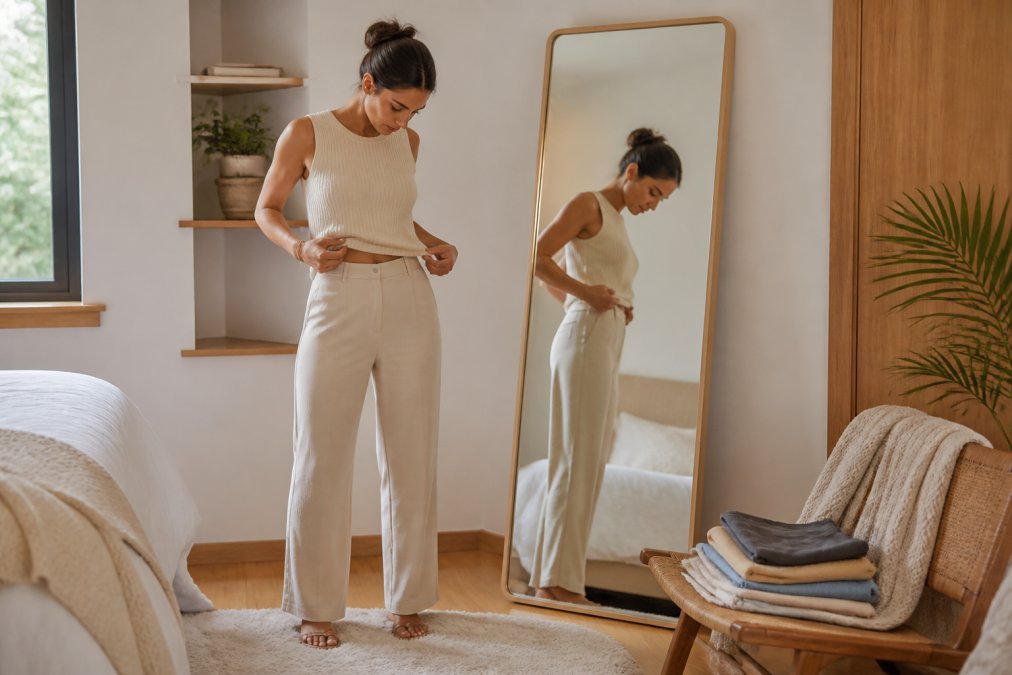
Stand in front of a mirror in fitted clothing. Look at three things: where your waist naturally sits, whether your shoulders or hips are wider, and how your torso length compares to your legs. That's it. No measuring tape required, no categories to accept or reject. Proportion is neutral information, and it tells you which silhouettes will feel effortless.
| Proportion Signal | What It Suggests | Try This |
|---|---|---|
| Longer torso, shorter legs | Raise the visual waistline | High-rise bottoms, tucked tops, shorter jackets |
| Shorter torso, longer legs | Balance the vertical line | Cropped jackets, mid-rise fits, longer hems |
| Broader shoulders | Soften the top line | V-necks, raglan sleeves, draped knits |
| Broader hips | Balance lower volume | Straight-leg trousers, structured tops, darker bottoms |
| Balanced proportions | Play with texture and color | Column dressing, monochrome, statement layers |
Silhouette Mechanics That Actually Change How an Outfit Reads
Four silhouettes cover most outfits you'll build:
- Column, top and bottom share a similar width (straight-leg trousers with a boxy top). Reads clean and modern.
- A-line, narrow at the top, wider at the bottom (fitted tee with a full skirt). Reads soft and feminine.
- Inverted triangle, wider at the shoulders, narrower at the hips (structured blazer with slim trousers). Reads sharp and authoritative.
- Hourglass, defined waist with balanced top and bottom (wrap top with a pencil skirt). Reads classic and intentional.
None of these is better than another. The point is to pick the one that matches the feeling you want that day, then adjust hem lengths and fabric weight until the line holds.
Fit and Tailoring: The Cheapest Upgrade You Can Make
Fit and tailoring matter more than any single silhouette rule. A well-fitting basic beats a trendy piece that pulls at the seams every time. Three alterations do most of the work:
- Hem length, trousers and sleeves that end at the right spot change the whole proportion.
- Waist suppression, taking in a waist by an inch or two turns a shapeless dress into a defined one.
- Shoulder seam, the seam should sit at the edge of your shoulder, not past it. This single fix makes jackets and knits look intentional.
How to Build a Capsule Wardrobe That Still Feels Like You
A capsule wardrobe is a small, curated closet of interchangeable pieces built around your actual life, not a fantasy version of it. The point isn't minimalism for its own sake. It's making every item earn its place, and the way to know whether it earns its place is math, not vibes.
- Two bottoms that fit well and work with most tops
- Three tops in your core color palette
- One layer for temperature and texture
- One pair of shoes you'd wear three days a week
- One piece that's purely self-expression
The Cost-Per-Wear Calculation That Changes What You Buy
Cost-per-wear is the price of an item divided by the number of times you actually wear it. A $20 top worn twice costs $10 per wear. A $100 jacket worn 50 times costs $2 per wear. Run this math before you buy, not after. It reframes "expensive" entirely.
Here's the framework most style guides skip:
- Estimate wears per year. Be honest. A wedding-guest dress might get one wear. A neutral blazer might get 40.
- Estimate years of use. Fast fashion often lasts one or two seasons. A well-made piece can last five or more.
- Divide price by total wears. That's your real cost per wear.
- Compare across options. A $200 jacket worn 200 times ($1/wear) beats a $40 jacket worn 10 times ($4/wear) every time.
Where the Capsule Ends and Self-Expression Begins
A capsule isn't a uniform. The one piece that's purely self-expression is not a loophole, it's the point. The capsule handles the logistics so the expressive piece can do its job without competing for attention. If your capsule feels boring, the fix isn't more pieces. It's a stronger signature piece.
How to Find Your Style When Trends, Budget, and Doubt Get in the Way
The biggest barrier to finding your style isn't lack of options. It's psychological. Many people avoid experimenting because they're afraid of looking foolish, being judged, or "getting it wrong."
How to Find Your Style as It Evolves With Age, Career, and Identity
Your style will change. That's not failure, it's evidence you're paying attention. A 19-year-old's wardrobe shouldn't look identical to their 35-year-old self's, and a career shift often reshapes what "professional" even means to you.
Frequently Asked Questions
What is the 3-3-3 rule for clothes?
The 3-3-3 rule is a packing and wardrobe shortcut: three tops, three bottoms, and three pairs of shoes that all mix together. It creates nine outfit combinations from nine items. Use it when you travel, or as a test for whether a new piece earns its place in your closet. If a purchase does not pair with at least three things you already own, it is probably a one-off rather than a wardrobe staple.
What are the three C's of personal style?
The three C's are commonly described as color, cut, and character. Color sets your palette, cut covers fit and tailoring, and character is the personality your outfit communicates. Working through them in that order keeps you from buying statement pieces before you have a base. If your outfits feel off, check which C is weakest: a great silhouette in the wrong palette will still look unsettled.
How do I stop following trends and find my own look?
Give every trend a 30-day waiting period before you buy. If you still want it after a month, and it fits your color palette and existing wardrobe staples, it is worth trying. Unfollow accounts that make you want to buy rather than think. Build a mood board of outfits you would wear on an ordinary Tuesday, not a red carpet, and let that guide your purchases.
How can I build a wardrobe that reflects my personality?
Start with a wardrobe audit: pull everything out and note what you actually wear, what fits, and what you avoid. Then write three words that describe how you want to feel, such as calm, sharp, or playful. Use those words as a filter for every new purchase. Personality shows up in details like fabric quality, proportion, and accessories more than in loud prints.
How do I identify my personal style aesthetic?
Save 20 to 30 images of outfits you genuinely love, then look for repeats: the same silhouette, color family, or fabric keeps appearing. That pattern is your aesthetic. A personal style quiz can speed this up by narrowing broad categories, but the images you save are the real evidence. Name the aesthetic in three words so it stays useful when you shop.
Does finding your style get harder as you get older?
It changes rather than gets harder. Careers, bodies, and priorities shift, so the style that worked at 22 may feel wrong at 35. Treat your wardrobe as something you revise, not something you finish. A short review each season, checking fit and cost-per-wear, keeps your closet aligned with who you are now instead of who you were.